On World Mission Sunday, the Catholic leader of Mongolia will give the homily at the 10:15 Mass at St. Patrick’s Cathedral
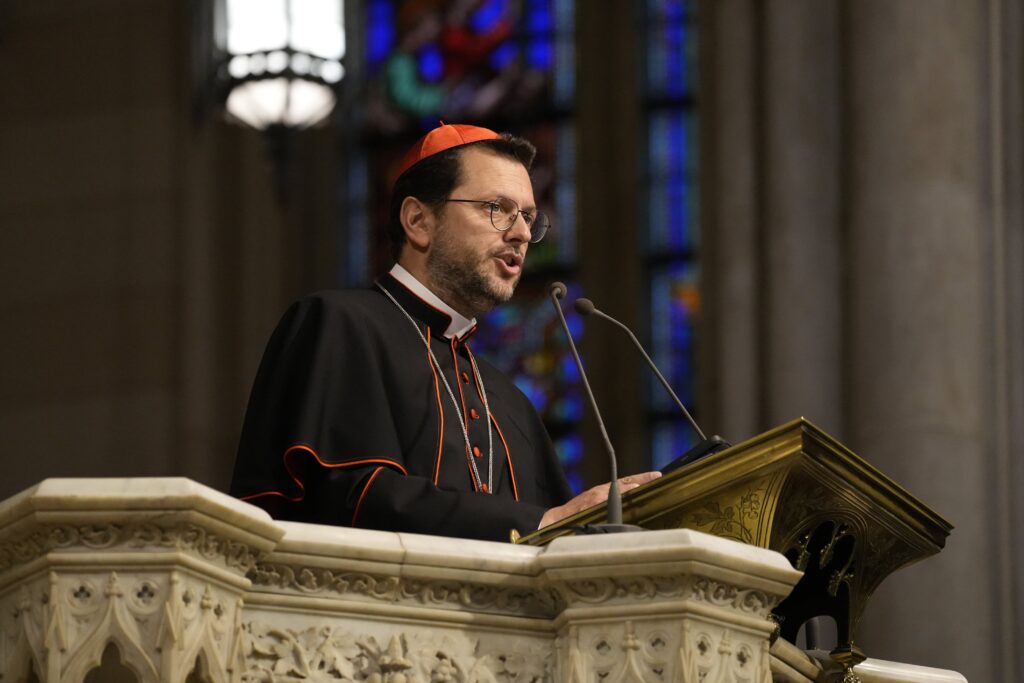
In September 2023, Pope Francis brought the world’s spotlight to one of his smallest flocks: 1,500 Catholics in the former communist nation of Mongolia. There to receive him upon his arrival was Cardinal Giorgio Marengo, whom the Holy Father had created as the world’s youngest cardinal just a year earlier.
On October 19, World Mission Sunday, Cardinal Marengo will give the homily at the 10:15 Mass at St. Patrick’s Cathedral. The Good Newsroom sat down with the Apostolic Prefect of Ulaanbaatar, the Mongolian capital, to hear about his lifelong work as a missionary and the work that is just beginning in this Central Asian country.
The Good Newsroom (TGN): When you first became a priest, did you want to be a missionary right away? Did missionary work appeal to you early on?
Cardinal Giorgio Marengo: I felt that the Lord was calling me to this special consecrated life. For me, it was quite obvious to think of missionary life because my spiritual director was a Consolata missionary. I was truly helped by a retreat I attended in which they explained the beauty of the consecrated life in the Church, and that really was the last step of my discernment. At the end of high school, I decided to join the religious life in a missionary order.
TGN: You first went to Mongolia to serve when you were 29. Is that where you wanted to go?
Cardinal Marengo: We vow obedience to our superiors, so I was ready to go wherever I would have been sent, but in my last stage of formation, I felt called to go to Asia in general. At that time, for us, it was only South Korea, but precisely when I was concluding my studies in Rome, our society decided to discern on a new presence in a country where we had not been before, and the choice fell on Mongolia. I was so excited when I heard the decision had been made, but I would have never thought that they would have asked me to go there because I was only 29. One day, I got a phone call from my superior general saying, "You are assigned to Mongolia." I was very happy.
TGN: What kind of Church infrastructure was there when you arrived?
Cardinal Marengo: Well, the first missionaries arrived in 1992, and there were Congregatio Immaculati Cordis Mariae (CICM) missionaries who were pioneering in that area even before. At the beginning, the Church was called a mission sui iuris because it was starting from scratch, really. When I arrived there, the year before, in 2002, the Holy See elevated Mongolia to the rank of apostolic prefecture. A few months after I arrived in Mongolia, Monsignor Wenceslao Padilla, then superior of the mission sui iuris, was elevated to bishop and prefect. When we got into the country, there were 200 local Catholics.
TGN: What’s it like working in an area like that, where there's so much opportunity, but there's so little already on the ground?
Cardinal Marengo: It's a grace that we receive to share the joy of the gospel in a country where the possibility to know the Church, to encounter the Lord Jesus, is not so common because there are very few Christians around. It is really fascinating because it always reminds us of the fact that we cannot take anything for granted, and it is a constant kind of request to us to be authentic in whatever we do or say. It also gives a great opportunity to be creative in a way, to try ways, and then maybe to learn from experience if they don't work, to change, and to start from another angle. All of that is done with great respect for the local culture and their spiritual tradition, which are very profound. This is one of our points: to be able to understand the beating heart of the local culture in order to be able to share the gospel.
TGN:: What kind of dialogue do you have with, for example, the Buddhist community? How is that relationship?
Cardinal Marengo: From the very beginning, our first missionaries, the CICM missionaries and all the others who eventually came in, we were all convinced of the importance of entertaining a fruitful dialogue with all the representatives of all religious traditions because of course, the large majority of people identify with Buddhism, and it is crucial for us to understand this beautiful religious tradition and to have constructive dialogue with the authorities of their tradition. So that brought us to have a consistent network of good relationships.
That was even improved once more by the fact that this year, in January, a few weeks before Pope Francis was hospitalized, he received an official delegation from the main Buddhist authorities from Mongolia, who requested that meeting. It means that we really entertained a very positive dialogue with them, as well as with all the other religious traditions. And they know that the Catholic Church holds a pretty strong conviction that we share our richness, spiritual richness by entertaining dialogue. So, we have a very positive network of dialogue.
TGN: What can we as Catholics of the Archdiocese of New York do to support missions in general, but specifically the mission in Mongolia?
Cardinal Marengo: It's very important to know the fact that the Catholic Church exists in Mongolia because many people may not know it, and to support us with prayer, prayer is a fundamental dimension of mission. Then I would suggest getting informed about the number of projects we run that are all in terrible need of support because our main source of support comes so far from abroad. We are also trying to implement quite a courageous program of inculturation and training for missionaries, for local catechists. We need a lot of support in training, ongoing formation, and equipping the local community with the cultural tools to entertain a positive dialogue with the local culture. It would be important that everyone is aware of the presence of the Church in Mongolia and that everyone is responsible for the mission of the Church universally. We would be very grateful if people also engage in supporting our projects and becoming informed about them through our channels.
TGN: Tell us a bit more about the specific projects you are developing.
Cardinal Marengo: We are building up some funds that will be very beneficial for the running of our activities. One is called the Mongolian Mission Fund that corresponds to what we envision in terms of the needs of the Church in Mongolia, and my own personal vision of it. The second fund is called the Evangelization Fund, and it is aimed at empowering missionaries through media and through the printing of catechetical materials to spread the gospel in Mongolia.
We also have the Vocations Fund, aimed at sponsoring youth programs and seminary formation. We are going to have the first-ever seminary in Mongolia soon. We have a center for training, located in the outskirts of Ulaanbaatar, that represents the only center for training of missionaries and local catechists. We have the Caritas Mercy Campus, meaning the great involvement of the Church in social justice and promotion of human dignity through a number of projects, especially the House of Mercy Project, which was inaugurated by Pope Francis when he came. Last but not least, we are dreaming of the first Catholic monastery, a contemplative monastery in Mongolia. That would be a great support for a historical foundation. Never before has there been a Catholic monastery in Mongolia. We would like to start this brand-new project and we are quite convinced that through the presence of monks, of people devoted completely to prayer, the mission would benefit.